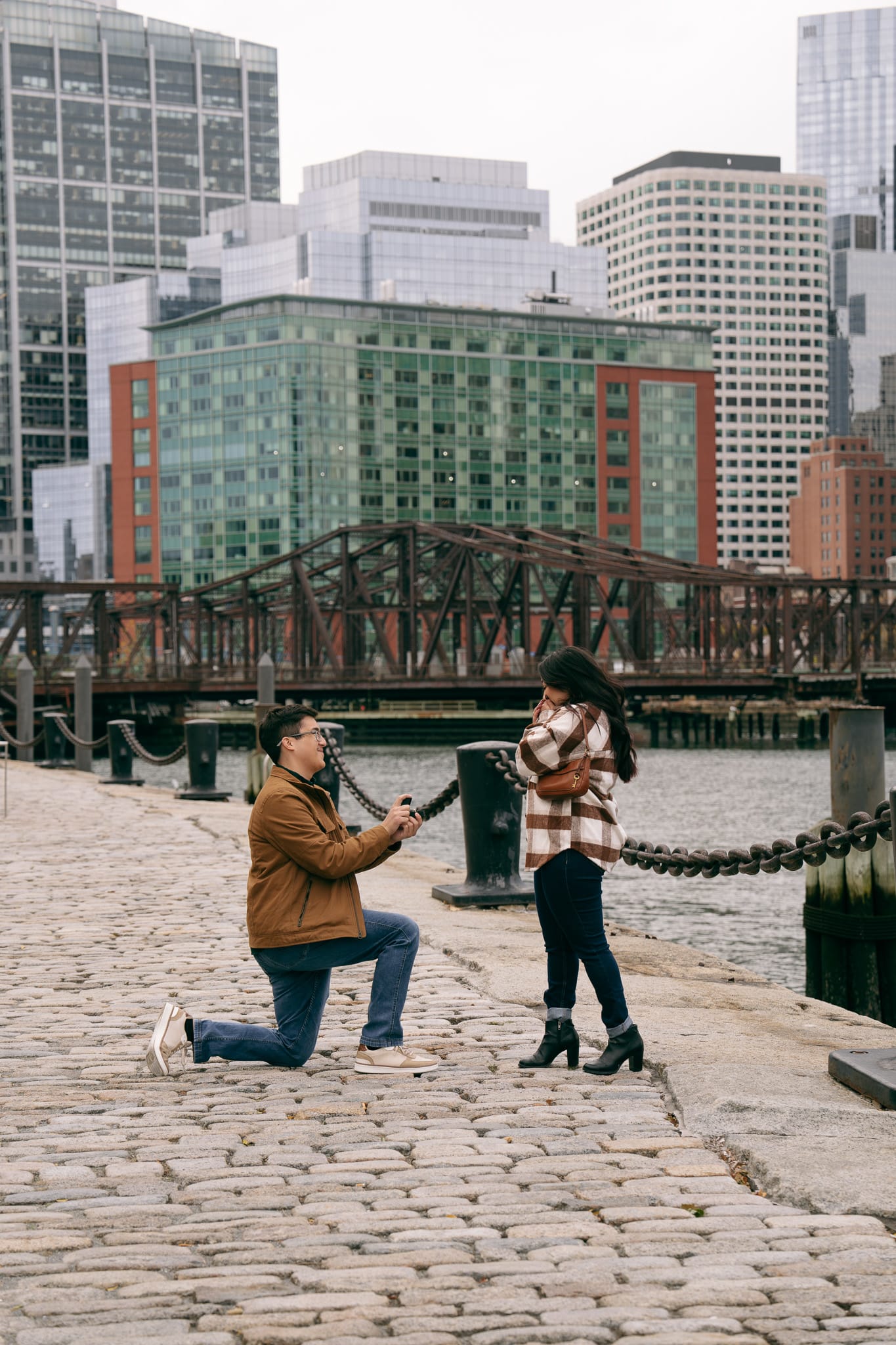
If it rains on your Boston proposal day, you have three good options: proceed in light drizzle (it photographs beautifully), move to a covered backup like the Boston Public Library or the Columbus Park trellis, or reschedule free of charge. The key is deciding the backup before proposal day — never the morning of.
The question I get more than any other — more than pricing, more than "how do you stay hidden" — is some version of what if it rains? It's the right question. You can't reschedule the ring, the nerves, or the dinner reservation as easily as a photo session, and New England weather has opinions. So here is exactly how rain actually plays out on proposal day, what your options are, and why some of my favorite proposal photos ever taken happened under gray skies.
The honest truth: overcast beats sunny
Photographers fight over golden hour, but the dirty secret is that a bright overcast sky is the most flattering light that exists. The clouds act like a giant diffuser — no harsh shadows, no squinting into the sun, colors that saturate instead of washing out. If your proposal day forecast says cloudy, you haven't lost anything. You've upgraded.
Actual rain is a different conversation, and it splits into two cases. Drizzle and light, intermittent rain: we usually proceed, and the photos get a moodier, cinematic quality you can't fake — wet cobblestones reflecting lamplight, a clear umbrella over the two of you, the city soft in the background. Steady or wind-driven rain: nobody enjoys that, the ring moment deserves better, and that's what the backup plan is for.
How the decision actually gets made
You should never be alone with a weather app the night before you propose. Here's the cadence I run on every booking: three days out, I check the forecast and flag anything concerning. The day before, we make a preliminary call — proceed, shift the time, or activate the backup. The morning of, we confirm. Boston forecasts firm up a lot in the final 18 hours, and rain here is often a two-hour event, not a day-long one — sometimes the fix is as simple as moving a 5 PM proposal to 2 PM, before the front arrives.
Rescheduling itself is free. That's not generosity, it's just how proposal photography has to work — a proposal isn't a portrait session, and treating a weather move as a penalty would push couples to gamble on bad conditions. We pick a backup window when we book, so the date can slide without the plan collapsing.
Boston rain, season by season
New England weather has a reputation, but it isn't random, and knowing the pattern takes most of the fear out of picking a date. Spring — April and May — is the greenest and least predictable stretch; it's also when the city looks lush, so I plan tightly around the forecast and lean on indoor backups. Summer rarely rains all day, but it trades steady rain for fast-moving afternoon thunderstorms and thick humidity, and a late-morning or post-storm evening slot usually threads the needle. Fall, especially late September through October, is the most settled window of the year here, which is one more reason it's peak proposal season. Winter swaps rain for snow, which photographs like a dream falling softly and like a problem blowing sideways.
Across the whole year, Boston sees measurable rain or snow on roughly a third of days, so some weather in your week is normal, not a catastrophe. The National Weather Service Boston office is the forecast I actually trust over app push-notifications, because it explains the timing and confidence behind a number instead of just flashing a cloud icon. When you tell me your rough date, I already have a sense of what that month tends to do.
The best covered and indoor backups in Boston
The strongest indoor proposal venue in the city is the Boston Public Library's McKim building — marble arcades, Bates Hall's green lamps, and a courtyard ringed by a covered arcade. It takes some advance coordination for photography, which is exactly the kind of thing that's easy when it's planned and impossible when it's a panic move at noon on proposal day.
Outdoors-but-covered, the trellis at Christopher Columbus Park gives partial cover with the harbor behind it, and Quincy Market's colonnades stay dry with Faneuil Hall character. And the most underrated rain plan of all is the one built around your cover story anyway: a private corner at dinner, a hotel lobby or rooftop arranged ahead, your own apartment staged while you're both "out." A proposal doesn't stop being a surprise because it moved indoors — it stops being a surprise when the plan falls apart and you start improvising.

The shots rain gives you that sun never will
It helps to know what you're actually trading for, because rain doesn't just "still work" — it unlocks a whole look. Wet pavement turns every streetlight, brake light, and shop window into a long colored reflection, so a quiet Beacon Hill side street or the brick around Faneuil Hall reads cinematic instead of ordinary. A clear umbrella becomes both a frame and a spotlight, pulling the two of you into your own little lit world while the city blurs behind the glass. Step under an awning, a colonnade, or just inside a café window and you get soft, directional light on your faces with the rain as a backdrop — some of the most intimate proposal frames I've ever made were shot from the dry side of a pane of glass.
Steam and breath show up in cold rain, lamplight goes warmer against a blue-gray sky, and nobody is squinting. The couples who end up loving their rain-day galleries the most are almost always the ones who were dreading the forecast the night before.
What to wear when rain is on the table
If there's any chance of weather, a few wardrobe choices make the difference between damp-and-glamorous and damp-and-miserable. Mid-tone and darker fabrics hide the occasional raindrop far better than pale linen or silk, which spot instantly and stay dark where they're wet. Closed shoes beat open ones on slick brick and wet grass — Beacon Hill's cobblestones and the Public Garden paths get genuinely slippery. If you're the one being surprised you won't know to prepare, which is exactly why planning happens with whoever is holding the secret: they can nudge an outfit, stash a backup top, and keep the umbrella in the car without giving anything away.
Two small things I'd put in any rainy-week bag: a clear umbrella (worth repeating) and a small microfiber towel to dry a bench, a railing, or the back of a coat between frames. Hair holds up better with a little product on a humid day, and glasses-wearers might bring an anti-fog cloth. None of it is fussy — it's the same quiet over-preparation that lets the proposal itself feel effortless.
Build the backup into the original plan
Every location guide on this site ends with the same advice in different clothes: the proposal that goes smoothly is the one that was planned twice — once for the day you're hoping for, once for the day you might get. When we plan your proposal, the backup location, the weather call schedule, and the reschedule window are settled before we ever talk about where I'll hide. It takes fifteen extra minutes and removes the only part of proposal week that's actually worth worrying about.
Start with the full planning walkthrough in how to plan a surprise proposal in Boston, see how winter changes the math in the winter proposal guide, or grab the free proposal planning checklist — the rain plan has its own line on it.
For the full picture, see my ranking of the 10 best proposal spots in Boston.